
Unraveling Tournament Format Effects on Decision-Making Processes in App-Based Card Gaming Scenarios
App-based card gaming has expanded rapidly since 2024, and tournament structures continue to shape how participants evaluate risks and adjust strategies during play. Different formats impose distinct constraints on chip stacks, blind levels, and payout distributions, which in turn influence choices about aggression, folding frequencies, and bankroll allocation.
Core Tournament Structures and Their Structural Variables
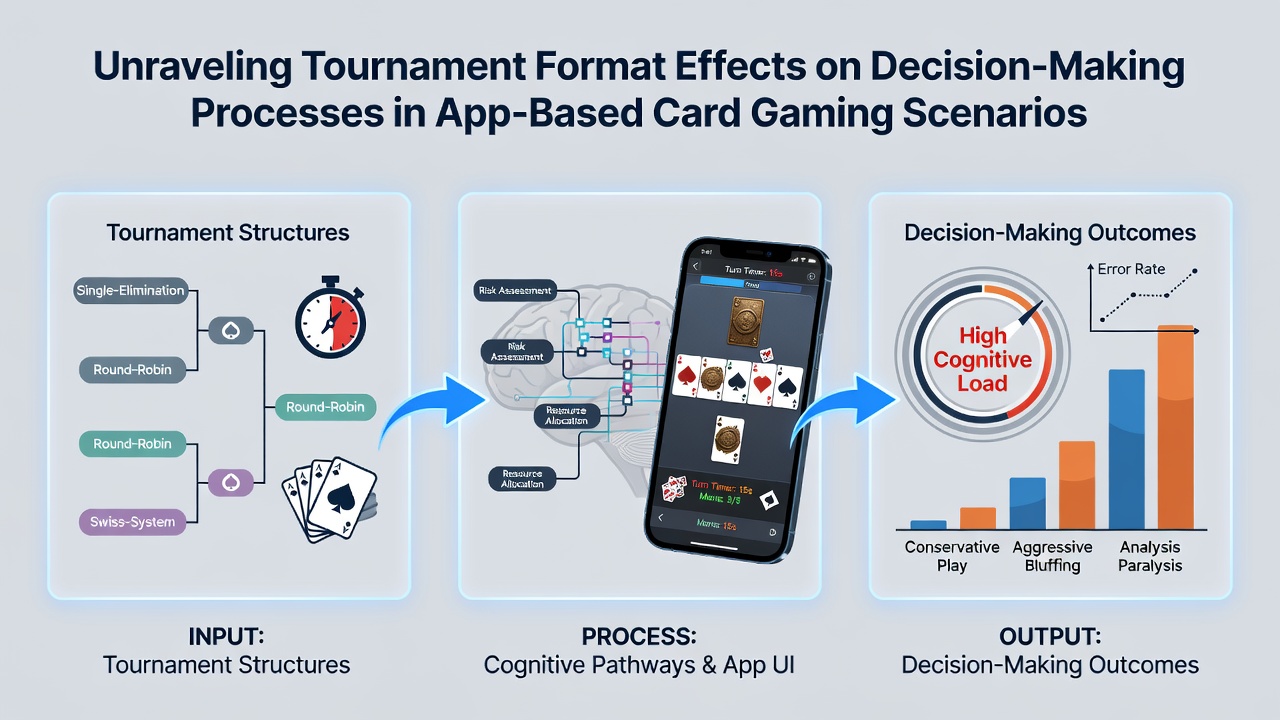
Freezeout events eliminate players once their chips reach zero, whereas rebuy and add-on formats allow additional purchases that extend survival windows. Researchers tracking session data across major platforms observe that freezeout participants tend to tighten early ranges because each decision carries irreversible stack consequences, while rebuy structures encourage wider opening ranges in the opening levels. Satellite tournaments feeding larger events add another layer because qualification thresholds alter the value of marginal hands near the bubble.
Blind escalation schedules further differentiate formats. Steep structures compress decision windows and push players toward higher variance lines, whereas slower schedules permit more post-flop evaluation. Mobile interfaces compound these effects through touch-based controls and notification systems that deliver real-time stack updates, sometimes accelerating reaction times compared with desktop clients.
Mobile Interface Factors and Real-Time Adjustments
App developers have refined push-notification timing and in-game timers during July 2026 rollouts, and these refinements intersect with tournament rules in measurable ways. Players receive alerts about approaching blind increases or table consolidations, prompting quicker pre-flop decisions that favor simplified heuristics over deep equity calculations. Studies conducted by the University of Nevada, Reno gaming research group indicate that shorter decision timers correlate with elevated fold-to-3-bet percentages across both Android and iOS deployments.
Network latency on 5G connections occasionally disrupts auto-action settings, forcing manual interventions that expose participants to additional cognitive load. Those disruptions appear more frequently in multi-table formats where attention must split across several active hands simultaneously.
Empirical Patterns from Platform Data
Aggregated telemetry released by several North American operators shows that participants in progressive knockout formats increase targeting of shorter stacks once bounties exceed 20 percent of the average stack. This behavioral shift emerges consistently after the third blind level and intensifies near payout bubbles. Canadian regulatory filings from the Alcohol and Gaming Commission of Ontario document similar patterns among provincially licensed apps, noting that bounty mechanics prompt earlier all-in confrontations than standard freezeouts.
European data collected through the Malta Gaming Authority's quarterly compliance reports reveals that satellite-format players exhibit higher survival rates when they adopt conservative pre-bubble strategies, yet the same cohort shifts to higher aggression once qualification becomes probable. These transitions occur within narrow time windows measured in minutes on mobile devices.
Decision Heuristics Under Format Constraints
Observers tracking thousands of hands note that rebuy-period aggression correlates with lower average return on investment once the rebuy window closes. Players who treat the rebuy phase as an independent bankroll segment often carry forward shorter effective stacks into the main event, altering post-rebuy risk tolerance. Push-fold charts embedded in many apps standardize responses during late stages, yet format-specific multipliers for bounty or satellite value require manual overrides that not all users apply consistently.
Hand-range visualization tools now integrate format parameters directly into mobile displays, and adoption rates climbed steadily through mid-2026. Those tools reduce calculation time but also standardize decision outputs across large user bases, potentially narrowing strategic diversity in popular formats.
Regulatory Context and Platform Reporting
Australian state regulators, including the New South Wales Independent Liquor and Gaming Authority, require operators to publish format-specific integrity metrics, and these disclosures have highlighted elevated dispute volumes around auto-fold settings during accelerated blind structures. The reports do not attribute causality but document correlations between timer length and player-initiated support tickets.
Academic analyses published in the Journal of Gambling Studies during 2025 examined North American and Asian app datasets and found that payout-structure steepness predicts earlier deviation from equilibrium strategies, particularly among mid-stack holders. These deviations scale with prize-pool concentration rather than absolute buy-in amounts.
Conclusion
Tournament formats establish boundary conditions that guide decision sequences in app-based card environments, and platform telemetry combined with regulatory disclosures continues to map those relationships. Mobile interface features, blind schedules, and payout mechanics interact to shape observable patterns in aggression, survival thresholds, and tool usage. Ongoing data collection through 2026 will further clarify how these variables evolve as both formats and devices advance.