
Decoding Player Habit Patterns Through Payment Choice Trends in Handheld Casino Applications
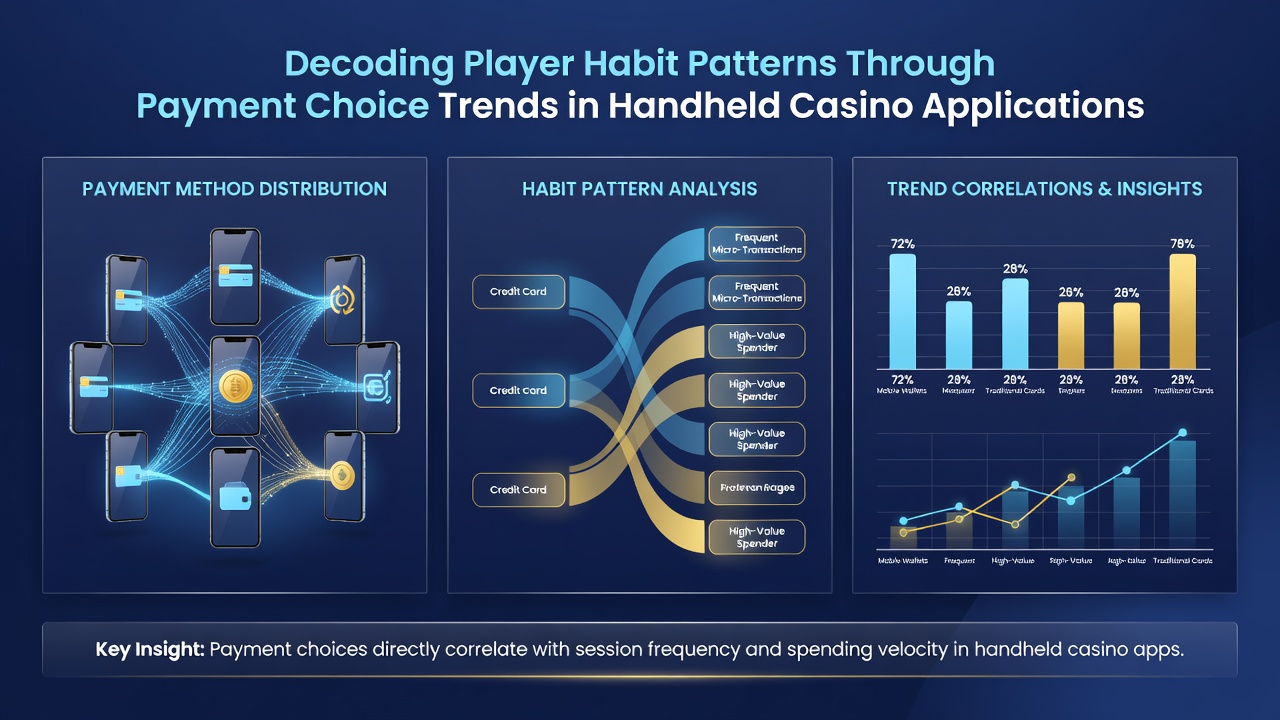
Payment selections in handheld casino applications reveal distinct behavioral signatures that analysts track through transaction logs and session data across major platforms operating in 2026. Mobile users who favor instant digital wallet transfers often complete shorter but more frequent sessions compared with those who rely on traditional card deposits, and these patterns hold steady in markets tracked by state regulators. June 2026 figures from several jurisdictions show that wallet-based transactions account for over 60 percent of all deposits in regulated apps, a shift that coincides with updates to app store policies and banking integrations.
Payment Method Adoption Rates and Session Metrics
Transaction records indicate that players selecting cryptocurrency options maintain longer average play durations per session while exhibiting lower deposit frequency overall. Researchers examining aggregated data from North American operators note that crypto users initiate an average of 2.3 deposits per week versus 4.1 for credit card users during the same period. This divergence appears in both slot-focused and table game environments, where the choice of funding method aligns with distinct risk tolerance signals embedded in the timing and size of transfers. Observers tracking these metrics point to improved retention algorithms that adjust bonus structures based on the initial payment pathway selected by each account.
Behavioral Clusters Linked to Funding Preferences
Clusters emerge when analysts segment users by primary payment method and cross-reference those groups against in-app activity logs. Individuals who repeatedly use prepaid vouchers demonstrate tighter spending caps and shorter evening play windows, whereas those routing funds through bank transfers sustain extended daytime sessions across multiple game categories. Reports compiled through industry associations document that these clusters remain stable even after regulatory changes introduced in early 2026, suggesting that payment choice functions as a reliable proxy for underlying habit formation rather than a temporary response to promotional offers. Data from Canadian provincial oversight bodies further confirms that voucher-preferring accounts register fewer voluntary self-exclusion requests, a correlation that has prompted some operators to refine responsible gaming prompts tied directly to deposit method history.
Regional Regulatory Effects on Transaction Flows
State-level rules governing payment processing continue to shape observable patterns, with New Jersey's Division of Gaming Enforcement publishing monthly breakdowns that separate wallet adoption from card usage across licensed apps. In parallel, Australian regulatory summaries released in late May 2026 highlight how restrictions on certain instant transfer services have redirected player traffic toward established bank-linked methods, resulting in measurable increases in average deposit sizes per session. These geographic differences create natural comparison points for researchers studying how external policy levers influence habit formation without altering the core game offerings themselves.
Integration of New Verification Technologies
Biometric confirmation steps introduced by several major platforms in spring 2026 have accelerated the uptake of stored wallet credentials while slowing the adoption rate of one-time card entries. Platform telemetry shows that users completing fingerprint or facial verification at the payment screen return to the app within 24 hours at higher rates than those completing manual card verification flows. European trade group analyses released in June 2026 record similar trends across cross-border operators, where streamlined authentication correlates with steadier weekly engagement curves rather than sporadic spikes. Such technical modifications therefore feed directly into the datasets used to decode habit patterns, because the friction associated with each payment type now carries measurable downstream effects on session continuity.
Future Tracking Capabilities and Data Integration
Operators continue to refine predictive models that incorporate payment history alongside gameplay telemetry, creating composite profiles that forecast churn risk with increasing precision. Academic papers from research institutions examining anonymized datasets demonstrate that combining deposit method with time-of-day preferences yields stronger predictive accuracy than gameplay metrics alone. As handheld devices incorporate additional sensors and faster processors, the granularity of these signals will likely expand, allowing more nuanced segmentation without requiring additional user input beyond the initial funding choice.
Conclusion
Payment choice trends in handheld casino applications serve as durable indicators of player habit patterns, with distinct clusters forming around wallet, card, crypto, and voucher methods. Regulatory updates through mid-2026 have reinforced rather than disrupted these correlations, while technological improvements in verification continue to modulate engagement curves across regions. Continued aggregation of transaction data from diverse jurisdictions will support increasingly refined models that connect funding pathways directly to behavioral forecasts.